Key takeaways
Finder has partnered with UN Women Australia to launch the Equal Pay Day Report.
The report uncovers the hurdles to women’s earning capacity.
One of the most striking revelations from the report is that 23% of Australians don’t care that a gender pay gap exists.
The data shows a significant gender divide in attitudes: men are more than twice as likely as women to say they aren’t concerned.
Another alarming finding is that over 1 in 5 Australians have experienced or witnessed gender-based pay inequality in their workplace.
Despite years of advocacy and progress, women in Australia continue to face significant hurdles when it comes to achieving equal pay.
A new report by Finder, in collaboration with UN Women Australia, shines a spotlight on the challenges that persist and the attitudes that may be holding back progress.

A nation divided: the gender pay gap
One of the most striking revelations from the report is that 23% of Australians don’t care that a gender pay gap exists.
That’s almost 5 million people who are either unaware of or indifferent to a critical issue affecting half the population.
The data shows a significant gender divide in attitudes: men are more than twice as likely as women to say they aren’t concerned.
Specifically, 16% of men ‘don’t care at all,’ compared to just 6% of women.
This apathy underscores a broader societal issue—there’s still a significant portion of the population that doesn’t see gender pay inequality as a problem worth addressing.
This indifference is a barrier to change, and it highlights the need for continued education and advocacy to shift public opinion.
Gender-based pay discrimination in the workplace
Another alarming finding is that over 1 in 5 Australians have experienced or witnessed gender-based pay inequality in their workplace.
Yet, of those who reported it, a staggering 58% said no action was taken.
This lack of response not only perpetuates the problem but also discourages others from coming forward.
Fear of repercussions and a belief that reporting won’t lead to any meaningful change further silences those affected.
These figures suggest that while awareness of the issue might be growing, the mechanisms in place to address it are still woefully inadequate.
Companies need to not only enforce policies against discrimination but also create an environment where employees feel safe and supported in speaking out.
The unseen burden: unpaid care work
One of the less discussed but equally critical aspects of gender inequality is the burden of unpaid care work.
According to the ABS data, women dedicate 64% of their average weekly work time to unpaid care, compared to just 36% for men.
Fast forward nearly two decades and little has changed.
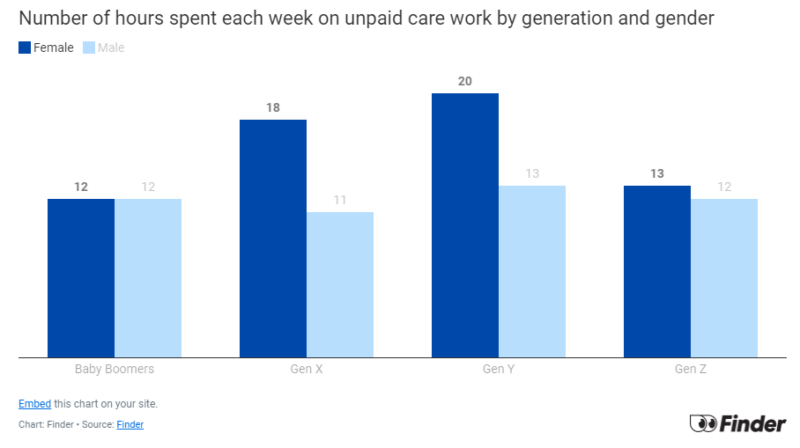
Finder’s report shows that women are still spending significantly more time on unpaid care work than men—16 hours a week on average versus 12 hours for men.
The disparity becomes even more pronounced during the child-rearing years.
Millennial women spend an average of 20 hours per week on unpaid care, compared to just 13 hours for their male counterparts.
This imbalance has a direct impact on women’s financial security and career progression.
As Sarah Megginson from Finder points out, the financial losses women endure during these years are difficult to quantify but are undeniably significant.
Household duties: a tale of two genders
When it comes to household duties, the gender divide is just as apparent.
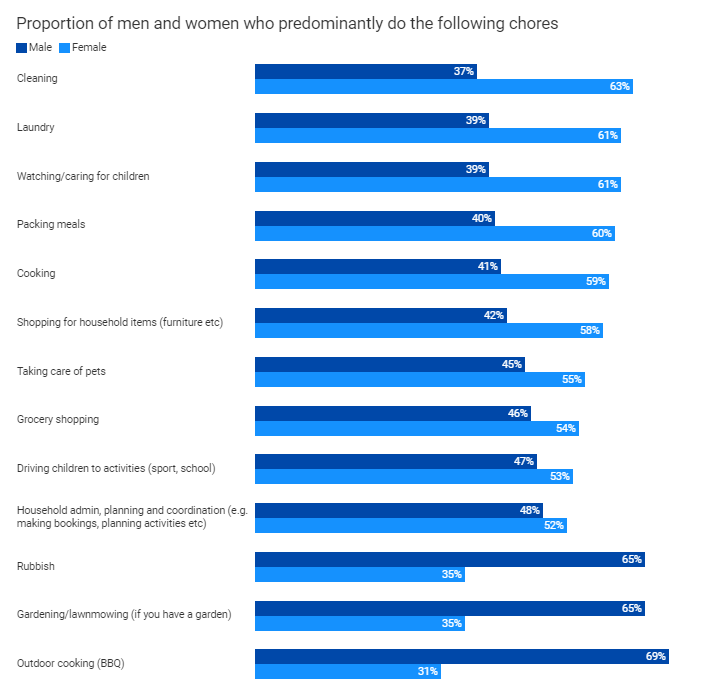
Half of the women surveyed say they are primarily responsible for household chores, compared to only 26% of men.
Tasks like cleaning and laundry overwhelmingly fall to women, while men are more likely to take on responsibilities like rubbish removal, gardening, and BBQing.
This division of labour is not just about who does what around the house—it’s a reflection of deeply ingrained gender roles that have real implications for women’s ability to participate fully in the workforce and achieve economic independence.
The impact of children and flexible work on women’s earning potential
The report also highlights how having children and seeking flexible work arrangements can hinder women’s earning capabilities.
Women are almost four times more likely than men to say that having a baby has negatively impacted their earning potential.
Additionally, 20% of women have chosen jobs that offer more flexibility to care for their families, compared to just 9% of men.
This need for flexibility, while essential for balancing work and family life, often comes at a significant financial cost for women.
It’s a stark reminder of the structural barriers that still exist for women in the workplace and the need for more supportive policies and practices.
Moving forward: what needs to change?
The findings from Finder’s report are reminders that Australia still has a long way to go when it comes to gender equality.
Simone Clarke, CEO of UN Women Australia, emphasizes that addressing these issues requires a multifaceted approach.
This includes improving access to affordable childcare, promoting flexible work arrangements, and challenging traditional gender roles and cultural norms.
But change isn’t just about policy—it’s also about shifting attitudes.
As Sarah Megginson from Finder advises:
“One of the most impactful steps women can take is to engage more deeply with their finances.
Small, consistent financial habits can help offset some of the economic disadvantages women face, providing a buffer in times of need.”
The journey towards closing the gender pay gap is far from over, but reports like this are crucial in keeping the conversation alive and pushing for the systemic changes needed to achieve true economic equality for women in Australia.