Key takeaways
Melbourne’s property market struggled to recover from the pandemic’s impacts, lagging behind other cities in terms of price growth by the time the first interest rate hike occurred in 2022. This made sellers more hesitant to list their properties, further slowing down the market’s recovery.
Market sentiment and buyer behaviour has changed since the last Residential Audience Pulse survey, with buyers more reluctant to purchase in the current environment and expectations tempered by reduced borrowing power and a more cautious view of the property market and economy.
Moving forward, demand for well located Melbourne properties is going to outstrip supply for some time to come, as immigration is at record levels and we’re not building anywhere as many properties as we require. At the same time, the rental crisis will only worsen.
Melbourne has long been one of Australia’s strongest property markets, standing tall alongside Sydney.
This has been thanks to its robust job market, high migration from overseas and interstate, and its reputation as one of the world’s most livable cities.
However, in recent years, home value growth in Melbourne has languished while other cities continue to experience strong growth.
In a notable shift, Brisbane’s median home value surpassed Melbourne’s in March for the first time in 14 years, making it the second most expensive city in Australia.
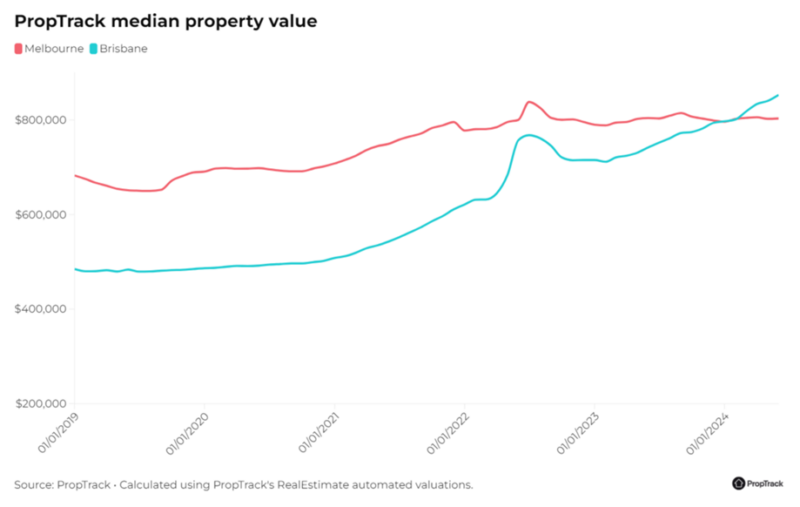
According to PropTrack’s data, Brisbane’s median house values grew by 4.4% during the quarter, compared to just 0.1% in Melbourne.
For units, Brisbane saw a 7.4% increase, while Melbourne experienced a slight decline of -0.1%.
By June, Brisbane’s house values reached $951,000 compared to Melbourne’s $912,000, and Brisbane’s unit values were $633,000 against Melbourne’s $619,000.
According to Karen Dellow, PropTrack’s Senior Audience Analyst, this trend isn’t new.
She commented:
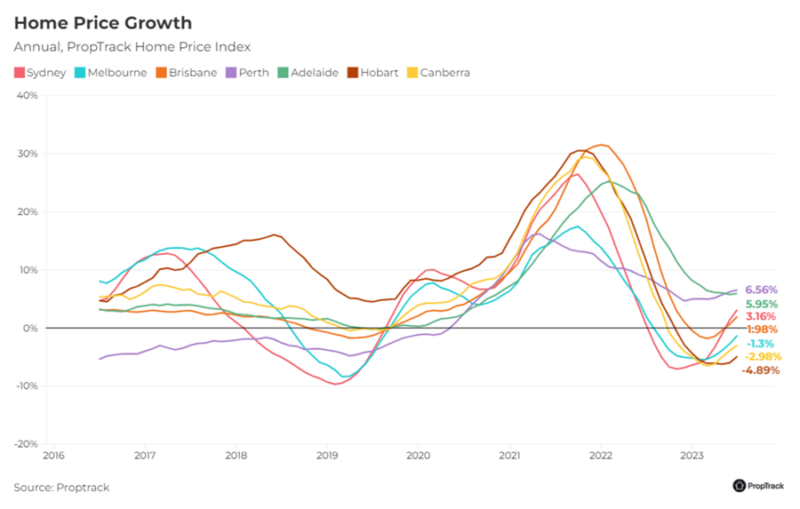
“Over the past year, Melbourne’s growth has been minimal, with house values increasing by just 0.3% and units by 0.2%.
In contrast, Brisbane experienced house value growth of 14.7% and unit growth of 20.3%.
Adelaide and Perth have also seen strong growth, suggesting that their house and unit prices could surpass Melbourne’s if these trends continue.”
Why is Melbourne lagging?
Ms Dellow noted that many of Melbourne’s challenges can be traced back to the pandemic, which hit the city harder than others.
Melbourne lost a significant portion of its population to interstate migration and faced closed borders, leading many investors to exit the market due to low demand for rental properties in the inner city.
She explained:
“Cities less affected by lockdowns, such as Brisbane, Adelaide, and Hobart, attracted interstate migrants and saw their property markets flourish.
Meanwhile, Melbourne (and to a lesser extent Sydney) struggled to recover from the pandemic’s impacts.”
PropTrack’s data show that home price growth in Melbourne remained sluggish throughout 2021.
By the time the first interest rate hike occurred in 2022, Melbourne was already lagging behind other cities in terms of price growth.
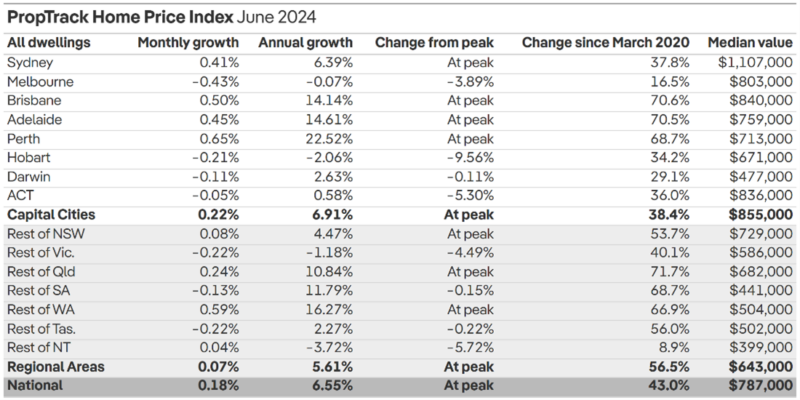
As of June 2024, Melbourne’s prices were 3.89% lower than their previous peak before the most recent downturn.
In contrast, Sydney, Brisbane, Adelaide, and Perth had already surpassed their previous highs to reach new price peaks.
This slower recovery has made sellers more hesitant to list their properties, further slowing down the market’s recovery.
Market sentiment and buyer behaviour
According to realestate.com.au’s most recent Residential Audience Pulse survey, only 19% of Victorian respondents considered it a good time to sell a property, compared to 37% in Queensland and 25% in New South Wales.
Higher interest rates and a higher cost of living have reduced borrowing power, making buyers more reluctant to purchase in the current environment.
This has led to more subdued auction clearance rates compared to the same time last year.
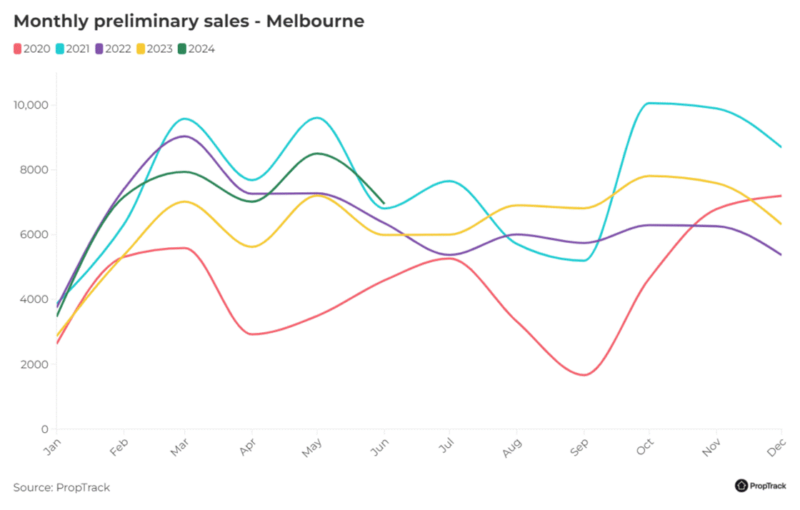
Nevertheless, buyers are still purchasing properties, with sales figures for Melbourne in June up 16% compared to last year.
However, buyer expectations have been tempered by reduced borrowing power and a more cautious view of the property market and economy.
As a result, they are unlikely to pay the high prices seen in more prosperous times.
In June, over half of the properties sold in Melbourne went for the asking price, more than one-third sold for less, and only 14% sold for above the asking price.
In contrast, over half of the sales in Brisbane and Adelaide went for more than the asking price, and in Perth, 77% exceeded the asking price.
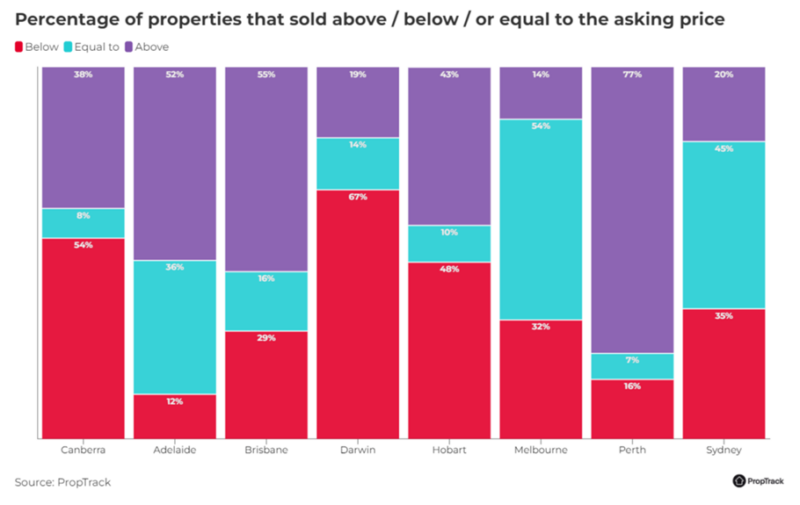
This conservative behaviour among Melbourne buyers partly explains the city’s lower median price growth compared to other cities.
The future outlook
Ms Dellow said that despite these challenges, Melbourne’s property market is not faltering.
Buyers and sellers remain active, and most market indicators are positive.
I see the current market offering a window of opportunity for property investors with a long-term focus.
Melbourne is at the stage of its own property cycle where Brisbane and Perth were three years ago.
Not that I suggest you try and time the market- this is just too difficult, and in truth, you’ve missed the bottom which occurred in early-2023.
But if the market hands you an opportunity like this, why not take advantage of it?
Taking advantage of the upturn stage of a new property has created significant wealth for investors in the past.
Moving forward, demand for well located Melbourne properties is going to outstrip supply for some time to come as we experience record levels of immigration at a time when we’re not building anywhere as many properties as we require.
At the same time, the cost of construction of delivering new dwellings will keep increasing, not only because of supply chain issues and the lack of sufficient skilled labour, but also because builders and developers will only commence new projects if they are financially viable and currently new projects will need to come on line at considerably higher prices than the current market price,
Of course, in due course, consumer sentiment will rebound when it becomes clear that inflation continues to fall and interest rates have peaked.
At that time pent-up demand will be released as greed (FOMO) overtakes fear (FOBE – Fear of buying early), as it always does as the property cycle moves on.
We are also going to be experiencing a prolonged period of strong rental growth – the rental crisis will only worsen further, with no end in sight.
Now I’m not suggesting taking advantage of tenants, what I’m suggesting is to recognise there is currently a problem (lack of rental accommodation) and provide a solution.
So rather than trying to hunt down a bargain, focus on buying an investment-grade property in an A-grade Melbourne location because these types of properties are in short supply but are still selling for reasonably good prices… Plus they’ll hold their value far better in the long term.
While it might feel counterintuitive to buy at a time when there are so many mixed messages in the media, you can benefit from less competition, low consumer sentiment, minimal downside risk and minimal risk of oversupply.